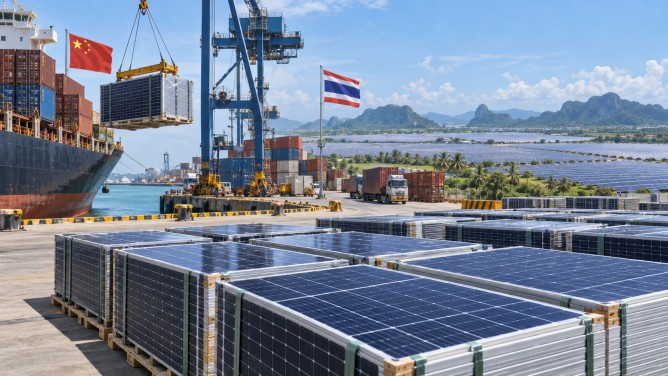
As Thailand accelerates its shift towards renewable energy, the country has witnessed a substantial increase in solar panel imports, primarily from China. Data from Thailand’s Ministry of Commerce and Customs Department reveals that solar panel imports surged by 88.7% year on year, reaching a value of $426.7 million in the first seven months of 2026. A staggering 99.3% of these imports originated from China, underscoring the growing dependence on Chinese solar technology.
Amid this surge in imports, Thailand is gearing up for a significant solar energy initiative. The government is designing a household solar installation program aimed at subsidizing solar panel installations for one million households, with subsidies potentially reaching THB 50,000 per household. This initiative could eventually expand to cover 1.5 million households, marking a major step in Thailand’s renewable energy roadmap.
China’s dominance in Thailand’s solar panel market is evident, with imports from the country amounting to $423.9 million, a 107.1% increase compared to the same period last year. In contrast, other suppliers like Singapore and Hong Kong contributed minimally, each accounting for only about 0.3% of the total import value. This reliance on Chinese imports highlights the need for strategies to bolster Thailand’s domestic solar manufacturing capabilities.
The Thai government is also exploring measures to reinforce its local solar panel production. Collaborations with the Ministry of Labour aim to equip workers with skills in solar panel assembly, installation, and maintenance. Additionally, discussions with the Board of Investment are underway to consider reducing duties on production inputs that are not readily available domestically, thus encouraging local manufacturing.
Through these efforts, Thailand hopes to foster a robust domestic clean-energy supply chain, lower household electricity costs, and promote the adoption of rooftop and ground-mounted solar installations. As the country continues to embrace sustainable energy solutions, these developments could significantly impact Thailand’s energy landscape and economic growth.