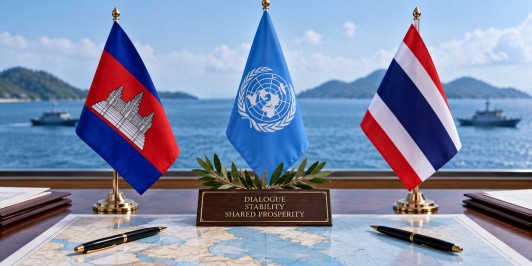
Cambodia and Thailand have embarked on a conciliation process supported by the United Nations to address a longstanding maritime boundary conflict in the Gulf of Thailand. This initiative is taking place under the framework of the United Nations Convention on the Law of the Sea (UNCLOS), with foreign ministers from both countries presenting their initial statements at the inaugural meeting. Cambodia is advocating for a definitive maritime boundary agreement with Thailand. Alternatively, Phnom Penh has proposed a collaborative development scheme that would enable the two nations to jointly utilize resources in the contested area.
Thailand, on the other hand, has expressed that the discussions should concentrate solely on establishing the maritime boundary. The Thai government has confirmed its commitment to participating in the process sincerely, although it had previously favored resolving the issue through direct bilateral talks. The maritime area in question, covering around 26,000 square kilometers, has been a point of contention for over 25 years, largely due to its potential wealth in natural gas and oil reserves, which adds significant economic stakes to the dispute.
In 2001, an agreement was reached to create a framework for the joint exploitation of resources within the disputed waters. However, this arrangement was terminated by Thailand in May, following a series of deadly border clashes that heightened tensions between the two countries. This disruption led Cambodia to initiate the compulsory conciliation process under UNCLOS in June, aiming to find a mutually agreeable resolution.
The UNCLOS conciliation process involves an independent panel tasked with providing recommendations to resolve the dispute. Although these findings are not legally binding for either party, they serve as a potential pathway towards a peaceful settlement. The ongoing efforts reflect both countries’ willingness to address the boundary issues through international legal mechanisms and dialogue.